
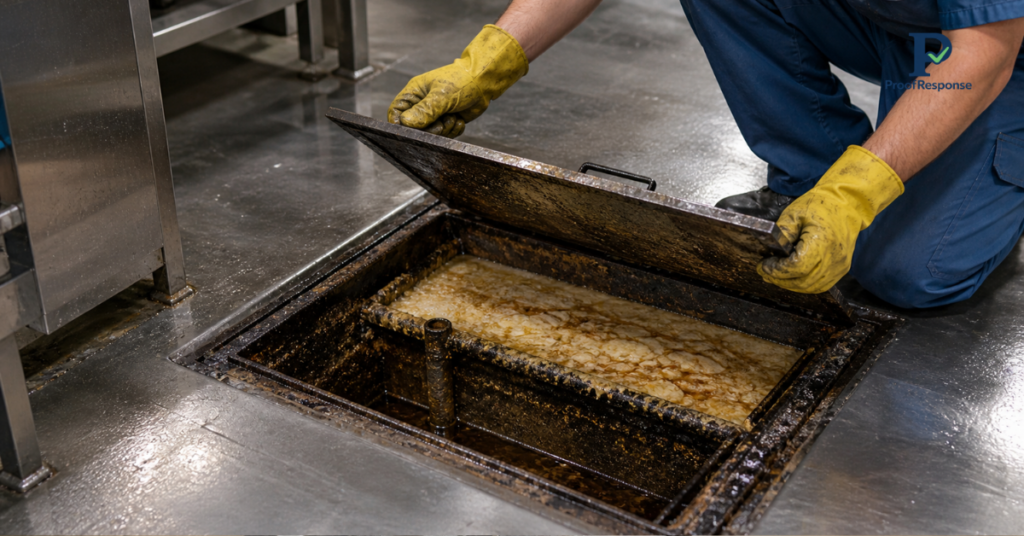
If you run a restaurant, knowing how often to clean a grease trap is not just good practice. It is the difference between a smooth kitchen and a very expensive, very smelly problem.
Most grease traps need cleaning every one to three months. But that range is wide for a reason. The right schedule for your kitchen depends on how busy you are, what you cook, and what your local health department requires. Let us break it all down so you can stop guessing and start planning.
What Is a Grease Trap and Why Does Cleaning Matter?
A grease trap (also called a grease interceptor) is a small tank installed under your sink or outside your building. Its job is to capture fats, oils, and grease (FOG) before they enter the city sewer system.
When FOG builds up, it hardens into a thick layer that blocks pipes. Sewer overflows, flooded kitchens, and hefty fines from your municipality can follow. In fact, the U.S. Environmental Protection Agency estimates that FOG is responsible for nearly 47 percent of the approximately 23,000 to 75,000 sewer overflows reported in the country each year.
Think of your grease trap like the lint filter on a dryer. Skip cleaning it once, and things still work. Skip it six times in a row, and you are looking at a fire hazard, or in this case, a sewage backup.
The Industry Standard: The 25 Percent Rule
Here is the most widely used guideline in the industry. Clean your grease trap when it is 25 percent full of FOG and solids. This is sometimes called the “25 percent rule,” and it comes from the Plumbing and Drainage Institute (PDI), whose standards are referenced by health departments across the U.S. and Canada.
Once a grease trap reaches that threshold, its efficiency drops sharply, and grease starts slipping through into the sewer. That is when you risk code violations and service disruptions.
Real-World Cleaning Schedules by Restaurant Type
Here is a look at what actual service providers and municipal guidelines recommend based on kitchen type:
| Restaurant Type | Trap Size | Recommended Frequency | Notes |
| Fast food or burger joint | 50 gal | Every 2 to 4 weeks | High fry volume |
| Full-service casual dining | 100 gal | Every 4 to 8 weeks | Moderate FOG output |
| Fine dining or steakhouse | 100 gal | Every 6 to 8 weeks | Varies with the menu |
| Bakery or cafe | 50 gal | Every 2 to 3 months | Lower grease output |
| Cafeteria or school kitchen | 250+ gal | Every 4 to 6 weeks | High daily volume |
What Your City Actually Requires
Many restaurants are surprised to learn that their local government has specific grease trap cleaning rules already written into law. These are not suggestions. They are ordinances, and ignoring them can mean fines, forced shutdowns, or losing your food service permit.
For example, the City of Los Angeles requires all food service establishments to clean grease interceptors at a minimum of once every three months, and to keep service records on file for at least three years. New York City’s Department of Environmental Protection mandates monthly inspections for many commercial kitchens, with full cleaning when the trap reaches the 25 percent threshold. The City of Chicago requires quarterly cleaning at a minimum, with a log provided to inspectors on request.
The key takeaway here is to check with your local sewer authority or health department directly. Most cities publish their grease trap ordinances online, and a quick call to your service provider can confirm what applies to your address.
Pro tip: Keep a cleaning log. Most municipal inspectors will ask to see it, and having a clean record on paper (literally) can save you from fines even if there is a minor issue during inspection.
FOG Volume Calculator: Estimate Your Cleaning Interval
You can roughly estimate how often you need service using a simple formula. This is the same logic that professional grease trap service technicians use when setting up a maintenance schedule for a new client. The formula works like this:
Cleaning Interval (days) = (Trap Capacity x 0.25) / Daily FOG Output
Here is a worked example. Say your grease trap holds 100 gallons, and your kitchen produces about 2 gallons of FOG per day (typical for a mid-volume casual dining restaurant).
(100 x 0.25) / 2 = 12.5 days
That means this kitchen should schedule cleaning roughly every 12 to 14 days. If you have a larger interceptor (say 500 gallons) and a lower output (0.5 gallons per day), that stretches out to 250 days, closer to twice a year.
Not sure of your daily FOG output? Ask your grease trap service company. They can measure it during a service visit and dial in a schedule that actually fits your kitchen rather than a generic one-size-fits-all recommendation.
Signs Your Grease Trap Needs Cleaning Right Now
Sometimes the schedule slips. Here is how your kitchen will let you know the trap is overdue:
- Slow or gurgling drains in the kitchen sink or floor drains
- A strong, sulfur-like or rotten egg smell coming from drains
- Grease or oily water backing up into sinks
- Your last service was more than three months ago
- You recently hosted a large event or an unusually busy period
The Bottom Line on Grease Trap Cleaning
So, how often should a grease trap be cleaned? For most restaurants, the answer is every one to three months, with busier or greasier kitchens needing service more frequently. Following the 25 percent rule, staying on top of your local ordinance requirements, and using a simple FOG volume calculation will keep you compliant, odor-free, and out of trouble with inspectors.
Do not wait for a backup or a fine to take grease trap maintenance seriously. Set up a recurring service schedule with a licensed provider, keep your cleaning logs organized, and treat it like any other critical piece of kitchen equipment. Your pipes, your staff, and your health inspector will all thank you.
Knowing how often a grease trap should be cleaned is only half the battle. The other half is having a reliable team to handle it on schedule, without you having to chase it down every few weeks. ProofResponse’s Commercial Wastewater and Tender Support team works directly with food service operations to set up cleaning schedules, maintain compliance records, and make sure you are never caught off guard by an inspection. Get in touch today and take grease trap maintenance completely off your plate.