
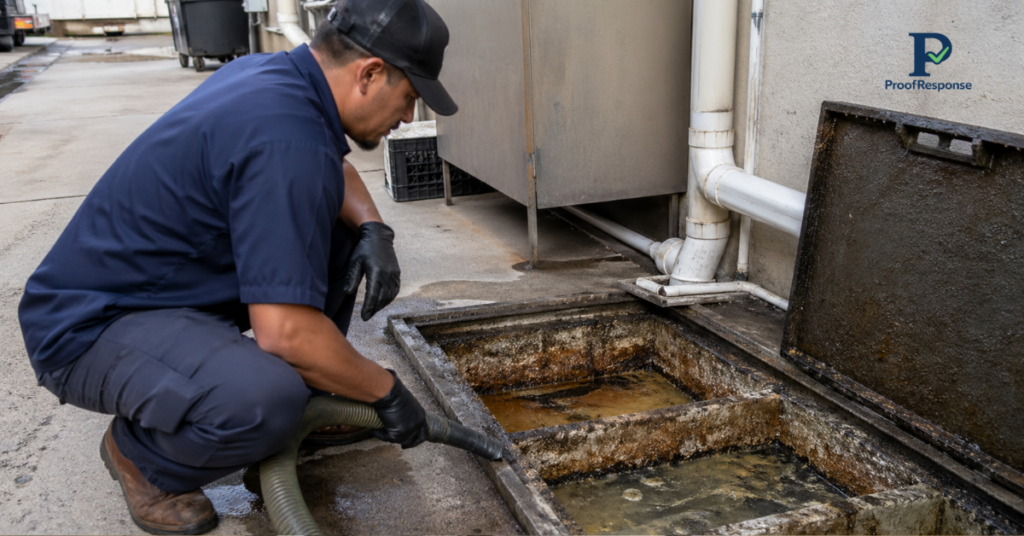
If you have ever wondered what keeps restaurant grease out of the city sewer, the answer is buried just outside the back door. So, what is a grease trap? It is a plumbing device that catches fats, oils, and grease before they ever reach the wastewater system. Quiet, unglamorous, and essential.
Let us pull back the lid and take a real look inside.
A single emergency grease trap service can cost 3 to 4 times as much as regular maintenance, and a typical restaurant loses $500 to $5,000 in revenue for each hour of unexpected kitchen shutdowns.
The Simple Version: How It Works
A grease trap is a settling tank. Wastewater from the kitchen flows in, slows down, and the different substances separate by weight. Grease and oil float to the top. Heavy food solids sink to the bottom. The relatively clean water in the middle flows out to the drain.
Think of it like a snow globe. Shake it up, and everything is mixed. Let it sit still for a moment, and the layers sort themselves out. A grease trap does exactly that, all day, every day.
A Look Inside: The Components That Matter
Most people never see the inside of a grease trap. Here is what is actually in there.
The Inlet Baffle
Wastewater arrives warm and moving fast. The inlet baffle slows it down the moment it enters the tank. Without this deflector, the rushing water would mix everything back together, and the separation process would never happen properly.
The Main Chamber
This is where the magic (and the mess) happens. The grease cap on top can be an inch or two thick in a well-maintained trap. In an overdue one, that layer becomes a dense, congealed mass, yellowish to grey, with a sharp rancid smell. Field experience makes this very real, very fast. Opening a neglected trap is not something you forget.
The Outlet Baffle and Exit Pipe
The outlet baffle is positioned to draw only from the clean middle layer, keeping the floating grease and sunken sludge from escaping. When a trap is too full, that grease cap pushes down into the middle zone and starts sneaking out. That is when drains back up and problems become visible.
FOG (Fats, Oils and Grease): How It Builds Up
FOG stands for Fats, Oils, and Grease. It comes from cooking oils, butter, meat fats, sauces, and dairy rinsed off dishes. Even with careful plate scraping, a busy kitchen sends a significant amount of FOG toward the drain every single shift.
Here is what accumulation actually looks like over time.
In the first week or two after a cleaning, the trap looks nearly clear. A thin film floats on the surface. By week four, a visible grease layer has formed and started to congeal. By weeks six to eight in a high-volume kitchen, the cap can be three to four inches thick, and the odour shifts from a kitchen smell to something sulfuric as bacteria break down the organic waste.
One of the most common myths is that hot water flushes grease away. Hot water keeps the grease liquid long enough to travel through the pipe. The moment it cools, it solidifies right where it settles. Inside the trap, temperature drops between meal services, and that cycle of melting and re-hardening is exactly what builds the dense layer you see at cleaning time.
How Often Does It Need Cleaning?
The industry standard is the one-quarter rule. When the combined depth of the floating grease and sunken sludge equals 25 percent of the total water depth, it is time to pump.
For a busy restaurant, that typically means every four to eight weeks. For smaller operations, every three months may be enough. Skipping cleanings does not save money. Emergency pump-outs, plumbing repairs, and municipal fines cost far more than a scheduled service.
Warning Signs to Watch For
You do not always need to open the trap to know something is wrong.
Slow drains in the kitchen, especially at sinks and floor drains, are usually the first sign. A sulfur or rotten egg smell near the drain is a strong signal that bacteria are breaking down an overflowing trap. Gurgling sounds from the pipes mean water is being forced through a partially blocked passage. And grease appearing near outdoor drain grates means the trap has already overflowed.
Why It Matters Beyond Your Kitchen
Grease that enters the municipal sewer system does not just cause problems in your pipes. It combines with calcium compounds in sewage to form what utility workers call fatbergs, massive hardened blockages that can fill entire sewer tunnels and cause sewage overflows into streets and waterways. A properly maintained grease trap removes the vast majority of FOG before it ever reaches that point.
Conclusion: What Is a Grease Trap Worth to You?
So, what is a grease trap? It is the line between a smoothly running kitchen and an emergency call on your busiest night. Understanding how FOG accumulates and what the interior components actually do makes it much easier to stay ahead of problems rather than react to them.
If your grease trap is overdue for service or you are dealing with slow drains and unexplained odours, do not wait for a backup to force the issue.
Get professional commercial wastewater support from Proof Response before a small maintenance gap turns into a costly emergency.