If you have ever opened your energy bill and thought, “There has to be a better way,” you are not alone. Heating water is one of the biggest energy costs in a Canadian home, and most people are still doing it the old-fashioned way. That is exactly where a heat pump water heater comes in. And once you understand how it works, it is hard not to get a little excited about it.
So, What Is a Heat Pump Water Heater?
A heat pump water heater (also called an HPWH) does not generate heat the way a traditional electric water heater does. Instead of burning energy to create warmth, it pulls heat from the air around it and transfers that heat into your water.
Think of it like a refrigerator working in reverse. Your fridge pulls heat out of its compartment to keep your food cold. A heat pump water heater pulls heat from the surrounding air and uses it to warm your water. It is moving heat, not making it. And that is what makes it so efficient.
What Is COP and Why Does It Matter?
Here is where things get really interesting. The efficiency of a heat pump water heater is measured by something called the Coefficient of Performance, or COP. Do not let the term scare you. It simply tells you how much hot water energy you get for every unit of electricity you put in.
A traditional electric water heater has a COP of about 1. That means for every 1 unit of electricity, you get 1 unit of heat. A heat pump water heater typically has a COP between 2.5 and 4. So for every 1 unit of electricity, you get up to 4 units of heat.
In plain English? It can be up to 4 times more efficient than your regular electric water heater.
Who Is It Best For?
Heat pump water heaters work best in specific conditions, and knowing this upfront saves you from any surprises.
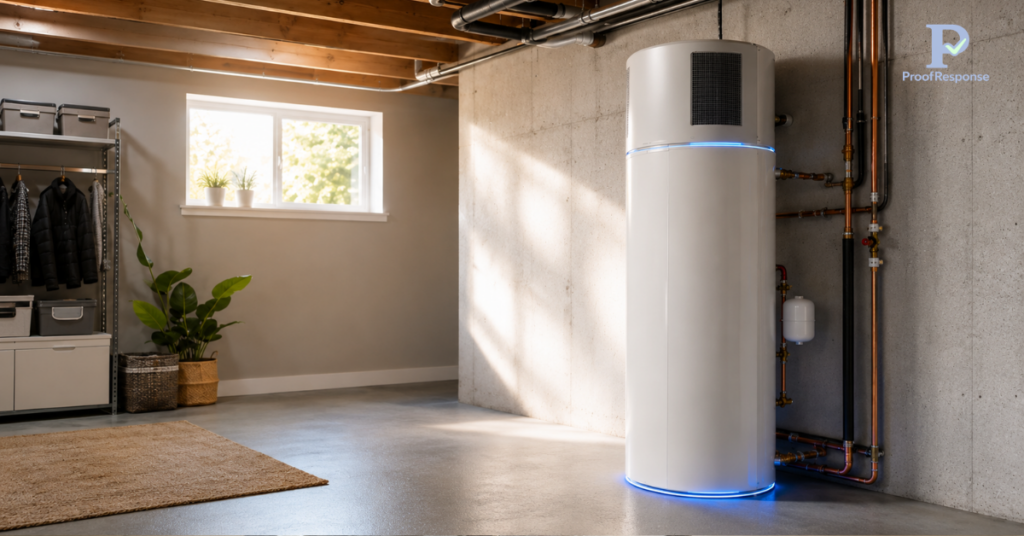
They are ideal for homeowners who have a space of at least 28 square metres (around 300 square feet) where the unit can sit. This could be an unfinished basement, a utility room, or a garage. The unit pulls heat from the air in that space, so it needs room to breathe.
They also perform best in locations where the ambient temperature stays between 4°C and 32°C year-round. In many parts of Canada, a basement fits this description perfectly, even in winter.
They are not the right fit if your only option is a tiny closet with no airflow. In that case, a traditional or tankless water heater might still make more sense for your setup.
Real-World Energy Savings
Let’s talk numbers, because this is where heat pump water heaters really shine.
A typical Canadian household spends between $400 and $600 per year on water heating alone. Switching to a heat pump water heater can cut that cost by 50 to 70 percent. That means savings of $200 to $400 every single year.
One homeowner in Ontario made the switch and reported dropping her annual water heating bill from $520 to just $160. That is a saving of $360 in year one alone. Over 10 years, that adds up to well over $3,000 in her pocket instead of her utility company’s.
Canadian Rebates That Make It Even More Affordable
Here is the part that often surprises people: you may not have to pay full price.
The Canada Greener Homes Grant (now transitioning into the Canada Greener Homes Loan and provincial programs) has offered incentives for heat pump water heater installations. Several provinces also run their own programs:
Ontario’s Enbridge and Hydro One rebate programs have offered up to $1,000 for heat pump water heater upgrades. British Columbia’s CleanBC program has provided rebates of $1,000 or more. Alberta and Quebec both have provincial energy efficiency programs worth checking before you buy.
Rebate programs do change, so always verify current amounts with your local utility or visit Natural Resources Canada’s website for the most up-to-date details.
When you factor in rebates, many homeowners find that the unit pays for itself in as little as 3 to 5 years.
Is a Heat Pump Water Heater Worth It in Canada?
If you have a suitable space, an electric water heater you are looking to replace, and you plan to stay in your home for more than a few years, the answer is almost certainly yes.
You will spend less each month on energy, reduce your carbon footprint, and likely qualify for a rebate that brings the upfront cost down significantly. It is one of those rare home upgrades that is good for your wallet and good for the environment at the same time.
Making upgrades to your basement, like installing a heat pump water heater, is a great step. But it is also the right time to make sure your basement is ready for it. If you have noticed any moisture along your walls or floor, it is worth getting that looked at before installation day. ProofResponse helps Canadian homeowners deal with basement leaks after snow melt and foundation seepage before small problems become expensive ones. And if a water-related incident ever leads to a complicated insurance situation, their water damage claim support team can help you navigate it quickly.